Category: Uncategorized

  •  SELF BELIEF AND SELF DOUBT

     SELF BELIEF AND SELF DOUBT

    Talk for Hampshire Writers, 13th January 2026.

    By Vanessa Gebbie.

    This talk followed a fascinating illustrated discourse by Martin White about the unfortunate and unfair portrayal of characters with albinism in literature and film.  

    I started by congratulating Martin on his great talk – which I found hugely important.  My self-doubt inner voice was saying, “Follow that, if you can…” 

    But my inner voice of self-confidence was also saying, “Don’t compare yourself with any other writer. Do what you do, as well as you can. “

    I think I’ll stick with that. 

    We started with a game of Word Cricket – which lasts about 10 minutes. Follow the link for details of the game – perhaps the most important thing to note here, is that those writers present were told there would be absolutely no reading out after the game had finished. No sharing of their responses. 

    After the game was up, and after I had given participants a minute or so to stop what they were writing, I asked for some feedback, specifically wondering how it felt to write like that. Writers were generous with their comments, including observations that it was exciting, surprising, freeing – and slightly worrying for  a few as they didn’t know what was going to happen next – but the overall consensus was that it had had a very positive effect on their creativity.  

    They knew their writing was not going to be judged – so any apprehension about failing was scotched from the start. Perhaps any self doubt was silenced in some measure?  

    I then moved into the talk itself.  As follows: 

    Some time back I was at Small Wonder Festival at Charleston, near my home, in Sussex. It was not long after my novel The Coward’s Tale was published and I was in excellent company – the prolific and experienced novelist Maggie Gee who had mentored me thanks to The Arts Council for the final year of edits, and her husband – broadcaster and Faber author Nicholas Rankin. Maggie was the first female chair of the council of the Royal Society of Literature. Nicholas Rankin’s next book,  the excitedly awaited Churchill’s Wizards – about The British Genius for Deception in both World Wars – was due to be published. We were sitting in the old barn at Charleston, on squashy sofas, near the tea table. Nicholas was very very quiet. That worried me – but Maggie said- ‘Oh don’t mind him, he’s always like this before a new book comes out.’  Then she added, ‘And I’m the same.’

    I was amazed. These two were among the most steady and  well respected of British authors, and yet they both had a crisis of confidence before a new book came out? Oh, sure, I’d been a gibbering wreck before The Coward’s Tale came out – but it was my first novel. I was allowed to be jittery. I’d expected seasoned writers to be more secure than that. 

    Far from it. These two had these recurring self-doubt episodes – but interestingly and importantly, they were able to pick themselves up and start again on the next project. How? What was going on? I knew that Maggie allowed herself a good length of time before embarking on the next big thing. Maybe this mystery was something to do with time? 

    A few years before that, as a very new writer, I’d been working in the company of a very dedicated and focussed writing group, led by another experienced, well published and equally dedicated writer and tutor. Part of the attraction to this raw newbie was the enormous confidence this tutor offered. Hard work would definitely pay off, they said, if you followed their specific system. Sure enough, it worked for me as some of us started producing short work which was good enough to get published online, occasionally in print, and to be shortlisted or placed in small competitions. Sounds great – but looking back, I had never asked myself two questions. 

    First, might this have happened anyway with hard work, and no ‘system’??

    Second – what about the others, successes or not? For some writers there, the system became destructive, as it wasn’t their natural way of creating, and they stopped writing. Their own confidence had taken a hard knock.  Self-doubt had won the day, sadly. The quiet voice of self confidence was shouted down. 

    When looking for quotes to illustrate this talk I stumbled on so many websites with advice on how to boost your self-confidence as a writer – aimed particularly at woman writers.  But reading much of it, I felt some was little more than a bleat about how the terrible world out there shatters our confidence – not forgetting the terrible world in here.  (I tapped my forehead – ‘’in here” equals inside our own heads!) In writing talks. Workshops. How they weren’t given nice, gentle feedback, and it ruined their lives. One of these advice-givers was a woman who had had some rigorous but tough honest feedback in her 20s, at a US University writing course.  And she didn’t write after that for thirty years. Echoes of my own writing group referred to above.

    That was so sad. I was and am asking myself, where was everyone’s little voice of self-confidence, pushing the ‘wronged’ to either walk away, or fight back? 

    My own experience outlined above was not all bad. Even though this was over twenty years ago, I learned a lot from that writer – not only about their interpretation of the craft and process of writing which happened to mostly chime with me and my own processes, but also how to analyse my own drafts and those of others, for flaws.  I learned too, that if I wanted to support, teach or mentor other writers, that far from touting one system that might work for me, that immense care and sensitivity is needed to understand and work with an individual’s own creative processes. 

    I’m sure we have all been in courses or workshops where a very confident teacher tells us theirs is the best, perhaps only way to do it. Because it has worked for them. Or we’ve experienced the writer with the loudest voice in a writing group holding too much power. As I did. Whereas actually, I suspect you know this – there are many many different ways to do this thing we love. You have your own way – I have mine – and sure, there are guidelines to sometimes understand and respect – but rigid rules, no. One way to do this? No, absolutely not. 

    This tutor had rules, and actually I tip my hat as they all made their way into The Coward’s Tale – in broken form – and I thoroughly enjoyed being wicked enough to break them with impunity.  A few examples – 

    You should never start anything with unattributed dialogue. So – the book begins with a line of unattributed dialogue. 

    Never start anything with comments on the weather. “It was a dark and stormy night…!!”  Every single chapter begins with a description of the wind blowing through a south Wales Valley’s town.  

    Well – Bloomsbury liked it – but hang on – what happened to me – the shivering wreck who would wake at three in the morning, to check the twelve characters, to recheck them, to run through each character’s narrative arc, to worry about their backstories, have I forgotten something important?  

    Somehow I knew that for all that, all my “3 in the morning” self doubt, I could also listen to my own inner quiet voice of confidence. Sometimes, I was totally secure in what I was doing – no worries at all.

    Here’s a quote from poet Charles Bukowski:

    Bad writers tend to have self-confidence, while the good ones tend to have self-doubt.

    I must say, I don’t entirely agree, do you? Isn’t it more nuanced than that? 

     I found this on Joanna Penn’s blog:  (The Creative Penn) 

    “Even famous writers suffer from self-doubt…”

    One year, (she says) I went to ThrillerFest in New York, which is the conference run by International Thriller Writers. Some of the biggest names in the world speak there.

    I went to one panel with authors like Lee Child, he writes the Jack Reacher books, and Sandra Brown, who’s one of the biggest romantic suspense authors, Clive Cussler, who writes action/adventure. Huge names in the thriller industry.

    R.L. Stine was there; he’s one of the most famous children’s writers, in fact, the most prolific children’s author in the world. He writes the Goosebumps series. These authors have been writing books for years.

    in the Q and A  A writer in the audience stood up and said, My manuscript is terrible. I feel like I  need to give up.”

    And all of the writers on that panel went down the line, and they all said,  ‘But I still feel that way’.”

    The point is – these were all hugely successful writers, selling in the millions – so maybe they actually NEEDED that self doubt to be successful? 

    Maybe self-doubt is not always our enemy then, any more than self-confidence is always a friend. 

    A lightbulb moment came for me at Bridport Festival some years back, when I heard Ali Smith and Jackie Kay  talk. They were discussing their writing processes, and at some point said something that chimed superbly with this topic:  

    “A Writer Needs Self Belief and Self Doubt in Equal Measure.”

    They said doubt and confidence need to work together. And they were not just talking about/to learner writers. 

    I’ve been at this writing game for almost twenty years now, won some prizes, had a range of books published, been commissioned to curate a creative writing text book that’s on recommended reading lists for courses in the UK and beyond.  And yet, I still doubt myself. Of course I do. It’s normal. 

    If you, newer writers, are waiting for those feelings to disappear when you get published, and you will … I have to disappoint you. It doesn’t get any easier, the further you go. If anything, it gets more difficult. 

    But – I’m arguing (in case you missed it!) that that’s a good thing. 

    I fully expect you to be shaking your heads by now. So – let me give you an example of useful self doubt and confidence straight from the horse’s mouth. Telling it as it is. This particular horse is called Roger Morris, writing as R N Morris, whose fourth novel ‘A Razor Wrapped in Silk’ came out with Faber well over ten years ago… He wrote this at the time:

    The unbearable weirdness of being published.

    I’ve got a book coming out on Thursday.  My fourth published novel. You’d think by now I’d be used to the experience but I’m not. I get incredibly apprehensive ahead of the publication date. My overriding instinct is to run and hide. I find the mental image of myself with a blanket over my head strangely comforting.  And yet, at the same time, I feel as though I should be doing everything I can to tell people about the event. So every now and then I scribble notes under my blanket and hold them out to whoever happens to be passing.  

    I veer between being worried that newspapers will ignore it, and I won’t get a single review, and terrified that it will be universally and humiliatingly panned. It never occurs to me that people might like it. 

    But he carries on regardless. 

    And what truly characterises my feelings about the fact of publication the thing that I really can’t get over, is sheer incredulity that it is happening at all. 

    R N Morris has now published many more novels. I asked him, via Twitter (X) how he feels now. No change, he said. He’s successful. Has been for over a decade. I’m arguing he is successful BECAUSE he sometimes feels like this.  And also because he is confident enough in his own creative abilities!

    This is what my own experience tells me, over and over:

    If we think we are just marvellous, we put a stop on our learning. If we just doubt, we don’t fight for anything. It’s that swing between doubt and confidence that enriches and drives us forward. 

    Quote: The writer who loses his self doubt should stop writing immediately. Sidonie Gabrielle

    When you decide to join a writing course, or even come to this talk,  you are arguably confident that you might find out things to help you with your writing  You are confident that this might be useful, that you CAN do it, that what you learn from reading, from tutors,  some peers will lead you a step closer to something  called ‘writing well’ – whatever you mean by that.

     And crucially, you have enough self doubt to know you don’t know it all. You need to learn. 

    It is already working for you, this pull between the two. You are already reacting to them both, letting the tension between the two pull you forward.  Even if, like me, it is easier to recognise the self doubt some of the time. 

    ….

    We’ve looked hard at untrammelled self doubt. But what of its oppo, over-self-confidence? We all know it when we see it in others, and can’t it be a pain sometimes? The writer who sits smugly in the corner away from the group, smiling quietly to themselves. They’ve cracked it. THIS is how it’s done. Best not share it too much in case it gets watered down. 

    I see it often, when I am working with the writers on online courses and residentials. I see plenty of tentative newer writers asking the rest questions and apologising for time wasting. (They never are!) And I see now and again the equally new writer who jumps in to answer the questions, with no caveats – with absolute certainty, that the way they do this thing is THE way. Do what I say and you’ll be fine.  (Look them up, thanks Mr Google – and you find that far from having a string of publications behind them to prove their theories are helpful… they have… not one. Its all hot air. ) This is unhelpful and untempered self-confidence. Unhelpful to others, and ultimately to themselves.

    I’d argue this is surface stuff, seeking positive strokes and ‘likes’. The confidence I am looking for, for us for is something else, something that comes from inside us, as creatives.  That little voice. We need to recognise it, nurture it and listen to it when it speaks to us. 

    We’ve all felt it. Sometimes, it’s like this – a feeling you begin to recognise which wraps your creative spirit in warmth even when you’ve been told by someone who is supposed to know, that you’ve got it wrong.  When the work you handed in comes back with ‘less than’ good marks, but something inside you says, “but hang on…” or when your writing group responds negatively to something you’ve written, and you suspect that some of them just don’t get it. Of course, they might be right, and you must explore why they are reacting like this – but please believe me – they MAY all be wrong. 

    What is real self-confidence in this writing stuff we do? I think it covers a lot, but mainly, isn’t it the knowledge that everything we write – and I mean EVERYTHING – is useful. Better than useful.  You had a right to write it.  To allow that to arrive, we need the confidence not to follow the herd. Not to make pastiches, but rather to create something different, in the real belief that our creation is just as valuable and may be more so, that what is already out there. 

    OK, it may not be ‘good’ yet in literary terms, But it has been born. It deserves respect from us, time, attention,  before we can start to edit.  

    And so what if those creations don’t ‘make it’ – whatever that means? Haven’t you learned something in the making of them? You’re not the same person who began the project. You’ve grown.

    Here’s a tale of creative self-confidence. I learned a huge lesson ages back from a CD I bought over twenty years ago on a long car journey, at a service station. It was audio of Fawlty Towers episodes, narrated by the late lamented Andrew Sachs, who played Manuel to John Cleese’s Basil Fawlty. It wasn’t so much what he recreated, however. It was the clips between the episodes – Cleese himself recalling how he’d written the episodes, with his wife Connie Booth. I remember him describing days of writing, and then evenings of more writing over bottles of wine, where the scripts would flow so easily. How they fell into bed exhausted, secure in the knowledge that tomorrow, after their heads had cleared, they’d start again. 

    Until one morning, the spark had gone. 

    Nothing.  Cleese was in such a panic, he rang one of the Monty Python team, to ask their advice. ‘Don’t worry,’ he was told. ‘Trust your creativity. It’s having a break.’ 

    And it was.  A couple of days later, the words flowed again. Ever since, when he hasn’t been able to write something,  he’s trusted that it would come back. 

    Much later, I met the writer Andrew Miller, whose first novel ‘Ingenious Pain’ won three awards. He said exactly the same thing. Trust the Process, is how he put it. 

    I’d put it like this; TRUST YOUR PROCESS. 

    One quote to remember:

     ‘It is IMPOSSIBLE to discourage the real writer. They don’t give a damn what you say, they are going to write.’ Sinclair Lewis. 

    Doubt is a friend. As is confidence. Listen to them both. Tune in. But, like all friends,  please don’t let either one take over. 

  • WORD CRICKET

    By Vanessa Gebbie.

    Here’s a little warm-up game. You’ll be writing as fast as you can. For about 10 minutes, with as little planning as you can muster.  And, importantly you will NOT be reading out what you wrote, or sharing it.  

    I’ll give you a starter sentence or two, and I want you to write as fast as you can – every minute or so I’ll chuck in a word. The only thing I ask is that you ‘catch’ the word as quickly as you can, and incorporate it into what you are writing as fast as possible. 

    (You can flex words – eg ‘change’ might become ‘changing’ or ‘changeling’ etc etc etc)

    In a workshop, the leader speaks the words out loud. If you want to play with this in your own space and time,  I suggest you write 10 random words on 10 scraps of paper, screw up the paper and stick all the bits in a pile on the desk where you write – so you don’t know which is which.  Then select one every minute or so.  Don’t cheat, and don’t choose another word if you don’t like your choice…

     You could set a timer, you could extend the time lapse to two minutes, three – whatever floats your boat. And you can start with whatever phrase you like. 

    But for now – enjoy the ride…

    Starter: 

    January 24th. Things are beginning to look a little serious…

    Your 10 words: 

    Dash

    Freak

    Handbrake

    Newspaper

    Tulip

    Sweat

    Purple

    Goldfish

    Icy

    Tomorrow

  • A New World

    A New World

    By Rachel O’Neill

    FIRST PLACE in November 2025 Competition

    I hurry towards the Great Hall, The November wind stinging my face. I should have had the litter and horses readied,  it never does does to deal with King Henry with red-rimmed eyes. The gossip of the marketplace is that he admires me. I confess it appeals to my vanity, that is, until I heard the words, ‘The Jewish whore does more than lend the King money, she lends her body too’.

     I am used to their envy. I could buy Winchester, its buildings, and its inhabitants many times over and they know this.

     Rounding the corner, towards the West Gate, I am deliberately jostled by two sniggering men.  I should have had one of my sons with me, or my maid, Alice. Though she is a servant, as a Christian, she is often afforded more respect than myself.

     I recover my balance and my dignity, and with deliberate slowness, I approach the Hall.  Inside the courtyard, a sudden eddy of wind pulls leaves and dust into a whirl. They dance, dervish-like. I shield my face, but when the wind drops, I am no longer outside the Castle. And the noise deafens me.  Metal carts career down the centre of the road without horses, huge stone buildings tower above me, and people clothed in strange garments walk past. They ignore me.  I am outside The Jailhouse, and it has transformed into a convivial place with men drinking ale in the pale autumn sunshine.

     What is this place? I look around and see a sign, ‘Jewry Street’. What is this new mockery? The crowd of strangers parts briefly and I see…I see a statue of myself!  I am holding the hand of my youngest, Asser. I am striding, purposeful. Strong. If this is the world I used to live in, it has changed. It has changed.

    Judge’s comments “An enjoyable read. I particularly liked the contrast between new and old. The way Licoricia was ignored also invoked something of her medieval surroundings and the modern world.”

  • Local Author Showcase April 2025

    On Saturday 26th April at the Winchester Books Festival, Hampshire Writers’ Society are organising a table in the Guildhall for local authors to showcase their work to the festival audience. Please drop by and support the authors if you can, and if you can’t come along in person, browse a selection of local authors’ books below.

    To celebrate the festival, some are offering free books or discounts — so make the most of this opportunity and pick up a bargain.

    WWI Drama

    Thriller

    Short stories set in Winchester

    Short stories

    Historical fiction

    Paperback reduced on Amazon

    Fantasy novella

    FREE eBook

    Techno-thriller novel

    Discount for in-person sales at Festival only

    Historical fiction set in Ancient Greece

    Children/YA

    eBook FREE 25th – 27th April

    Children’s book

  • Best of HWS 2014-2017

    Best of HWS 2014-2017

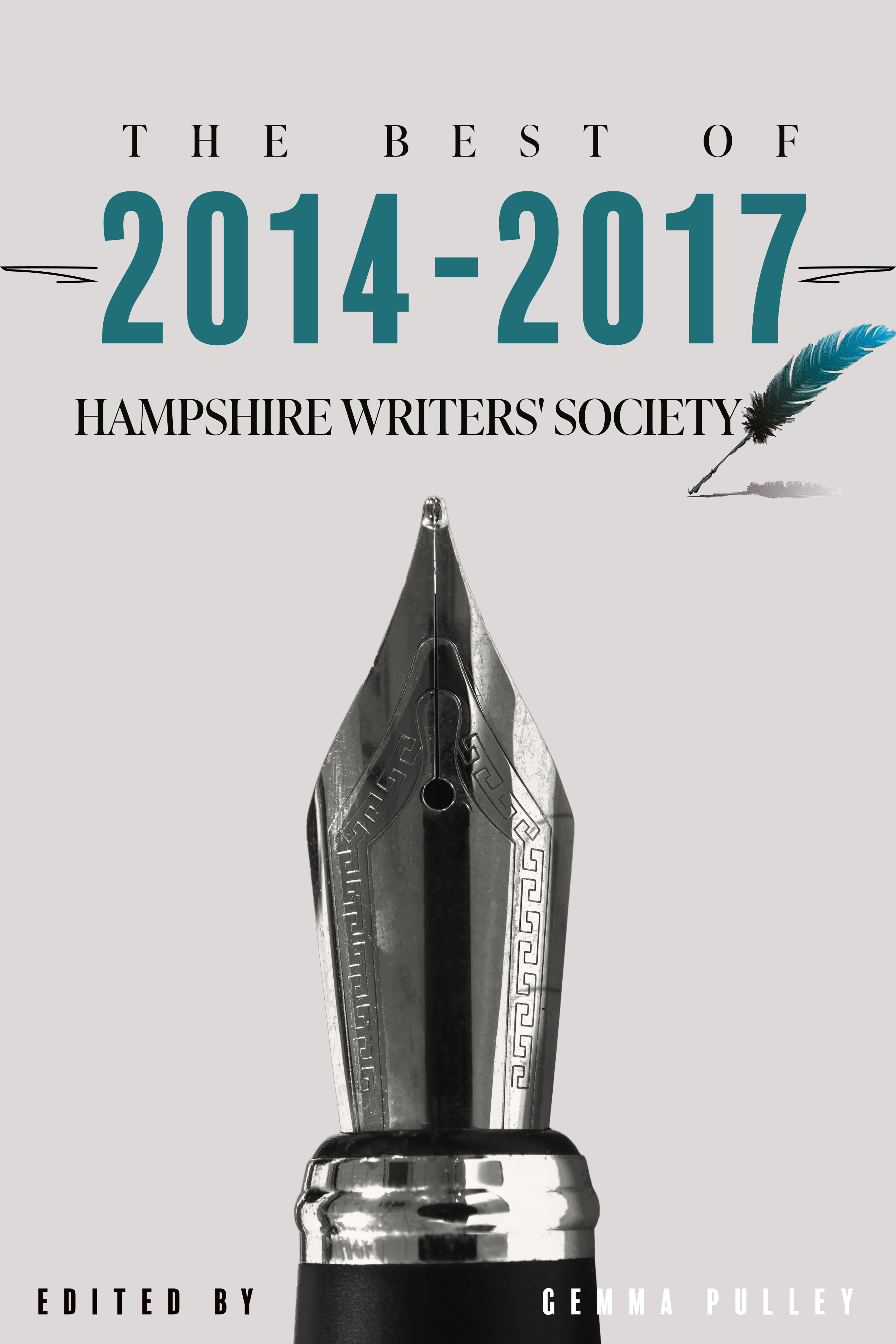
    The Hampshire Writers’ Society is pleased to announce the publication of a new volume in its Anthology series.

    The first volume in this series appeared as a print publication in 2015: Anthology of the Best of 2011-2014, compiled and edited by Barbara Large and Celia Livesey, with a foreword by Barbara Large.
    Now in 2025 as an electronic publication we have the following: The Hampshire Writers’ Society: The Best of 2014-2017, edited by Gemma Pulley, with a foreword by Gary Farnell. For his technical advice and support in the preparation of this volume, Gemma and Gary would like to thank Mark Eyles.

    This new e-book contains reports on HWS monthly meetings from September 2014 to June 2017, with some of the winning entries in the monthly writing competitions, along with the adjudicators’ comments where available.

    Preparations are already underway for The Best of 2017-2020, and comments and remarks on the 2014-2017 volume will be gratefully received as part of these ongoing preparations. Please email  inquiries@hampshirewriterssociety.co.uk to contribute.

    This new Anthology is freely available as an e-publication: to access your copy, please click on the link here.
    We are currently investigating a print version. If you are interested then please complete the form here. The price per copy in this case will be dependent on numbers but is not expected to exceed £15 per copy.
  • March 15th: Workshop with Judith Heneghan

    March 15th: Workshop with Judith Heneghan

    In 2025, Hampshire Writers Society has something new for our members. On Saturday 15th March, 10-12, at the Winchester Arc, we will hold the first of what we hope will be an ongoing programme of writing workshops.

    The first workshop is led by Judith Heneghan. Judith Heneghan is programme leader for the MA in Creative Writing at the University of Winchester, and a mentor with Jericho Writers. She has written over 60 books for young people, and her first novel for adults, Snegurochka (Salt, 2019) was shortlisted for the Edward Stanford travel writing awards. Her second novel, Birdeye, was published in 2024.

    Her workshop will focus on the power of setting when creating characters. Who are the natives, strangers and returners in your story, and how does this impact what they want and what they do?

    If you have a strong setting for a story but need inspiration for the characters and plot — or conversely, you have great characters but aren’t sure where to put them — this is the ideal workshop for you. Suitable for writers of all experience levels.

    Places are limited to 10 attendees. Priority will be given to members of the Hampshire Writers Society.

    This workshop is now fully booked. You can still email inquiries@hampshirewriterssociety.co.uk to register your interest in case places become available due to cancellations.

    For the complete workshops programme and more information on how booking works, see Workshops.

    Cost: Members £5, Non-members £20.

  • Book Fair 10th December

    Tuesday 10th December 2024 from 6.30pm followed by talks at 7.30pm at the Tower, King’s School, Winchester.

    It’s an opportunity to meet, network and chat to authors and members of HWS.

    Authors from the HWS will be displaying their books at the Book Fair along with an indie publisher. Come along, meet them and show support for fellow writers!

    Jean G-Owen

    Jean G-Owen, our guest speaker on the evening, her talk entitled ‘From Conception to Compilation: Publishing a Poetry Collection’. She will be promoting her new poetry collection, The Pain of Glass.

    NAKED FIGLEAF PRESS, founded by Jean G-Owen in Summer 2023, is an indie publisher
    based on the Isle of Wight. They specialise in poetry, novellas, short stories and non-fiction collections.
    They publish The Figlet, a bi-annual literary magazine showcasing Isle of Wight writers & illustrators. Naked Figleaf Press host Yarnival West Wight WordFest.
    xhttps://nakedfigleafcollective.co.uk/publications/


    Anne Wan

    Anne Wan, children’s writer and independent publisher, and author of the Secrets of the Snow Globe trilogy and picture book, Manners Fit for a Queen.

    Anne began writing when her middle son became ill. As he convalesced she helped him transform an idea that he had, into a book. This ignited her enthusiasm for writing stories for children. She started writing picture books as a hobby and went on to study creative writing with Barbara Large. Anne is passionate about inspiring children as readers and writers. She enjoys giving talks, craft and storytelling sessions in schools, libraries, and Brownie groups.

    Having completed the Snow Globe trilogy, Anne released her debut picture book Manners Fit for the Queen. In this humorous story, Hector causes chaos with his terrible table manners. His sister, Isobel, has found her own way to cope with the mess. But how will she cope when they are both invited to a tea party with the Queen?

    Secrets of the Snow Globe – Menacing Magic is the finale to my ‘Secrets in the Snow Globe’ series. Chaos rages in the world inside the snow globe following the theft of seven, magical, diamond snowflakes. In a race against time, Louisa and her brother, Jack, shrink into the globe and embark on a perilous journey to catch the thief. Can they retrieve snowflakes before the snow globe world is destroyed?

    Secrets of the Snow Globe – Vanishing Voices Can they succeed in their quest to help their new friends, and find a way back to Grandma’s house? A captivating adventure story of courage and friendship for 7-9 yrs. In a land of magic, snow, and secrets Louisa and her brother, Jack, are flung into a dangerous mountain adventure when they shrink into their Grandma’s snow globe.

    Secrets of the Snow Globe  – Shooting Star

    How much does Grandma know about the snow globe’s magic? Louisa and her brother, Jack, are determined to discover the truth. In this sequel to, Secrets of the Snow Globe – Vanishing Voices, Grandma’s story is revealed. But how much should she tell? After all, some secrets are best left untold…

    Are you ready for the magic?

    You can purchase the books from http://anne-wan.com/


    Martin Kyrle

    Martin Kyrle, travel writer.

    Martin Kyrle was at Agincourt – not the battle, but at the official opening of the museum.  His personal travel anecdotes – all of them true – span seven decades and will take you off the beaten track even if you’re familiar with the countries where they take place.

    Islands off the coasts of France, Holland or in Lake Baikal, the world’s deepest lake, castles in Estonia and Latvia, lakes in Lapland, Lithuania and Siberia, Roman amphitheatres in Libya, Neolithic dolmens in Brittany or monastic ruins 8 miles out in the Atlantic off far SW Ireland. Then being hospitalised in intensive care in the Canary Islands or facing a Force 8 gale on the ferry from Hong Kong to Macau and a total blackout in Mongolia when the lights fused..

    Finding soldiers bivouacking in his back garden prior to embarking for the Normandy Landings (but who hadn’t been told!), then trying to get to school during the ‘great freeze’ of 1947 contrast with exploring Mycenaean tombs in Cyprus or volunteering in a refugee camp in Austria and a workcamp in Poland.  Hitchhiking round North Cape at the top of Norway was quite tricky, too.  [Why go?  Well, it’s the northern limit of Europe and if you go any further you fall off…].

    He had to mind his manners when, as a Sub-Lieutenant in the Special Branch stationed in Malta to decode top secret communications, the Commander-in-Chief, Admiral Lord Mountbatten, invited him to dinner.  At university in Southampton a contrasting challenge was singing a duet from La Bohème in front of a couple of hundred disbelieving fellow students who’d sneered that although he and his fellow artistes could sing Gilbert & Sullivan they couldn’t sing ‘real’ opera.  After that, getting lost on a train in Western Bosnia, being locked in a church in rural Devon or standing with your school party watching your train from Germany into Denmark depart without you were minor misadventures you took in your stride.

    He ascribes his good fortune and possibly survival to having been blessed by the Pope in St Peter’s Square in the Vatican in Rome, by the Patriarch of the Russian Orthodox Church in the Kremlin in Moscow and by an indigenous Buryat shaman in Siberia who gave him a lucky charm, which you might think is hedging your bets for someone who’s a life-long atheist.  But perhaps they saved him when he had to overcome vertigo when standing on the top of the leaning tower of Pisa and when, 10,000 feet above the South China Sea on a flight to Beijing with his late wife, the pilot announced that one of his engines was showing signs of failure.

    Martin Kyrle’s Little Green Nightbook, Little Blue Nightbook and Little Orange Nightbook each has 25 personal stories to intrigue you, with flags, maps, colour photos and cartoons.  His other books, Jottings from the Trans-Siberian Railway and Jottings from Russia and the Baltic States.  Part 1: Russia and Estonia.


    Page Dalliance

    Page Dalliance is a writer, editor and designer who became an author by chance.  Having lived in and around the New Forest and the Test Valley in Hampshire for most of her life, where she married and raised her 3 children. 

    During this time she developed a design career and a thirst for knowledge, not present in her early school days, and consequently put it to good use in her future projects and exploits to improve her lifestyle.  Always up for a challenge where an opportunity presented itself, these were probably stepping stones for later adventures as a single woman where choices had to be made and calculated risks undertaken.

    This debut novel is based on the experiential events witnessed on her later travels when dipping her toe in to the tepid Greek waters for the first time at the age of 50 plus and then consequently ‘pushing the boat out’.

    Further publications are planned featuring design and building challenges both at home and abroad.

    Her new book, A Perfectly Respectable Pirate, a novel set in Greece is based on a true story.


    Clare Fryer

    Clare Fryer, YA author, her book, The Invitation.

    Clare grew up in Guildford surrounded by books. She was inspired to write by her father, who was a poet and author himself in his spare time. Clare doodled poetry throughout her life, yet yearned to write novels but never had the time.
    When Clare took early retirement in 2022, she finally had time to write. The Invitation began as a short story inspired by a writing prompt and won a monthly writing competition. Her mother and several friends asked what happened next, and so she began to write. That short story became the first three chapters of The Invitation.

    One invitation changes everything.
    The arrival of a mysterious invitation on the eve of Millie’s sixteenth birthday sets off a chain of events that will change her life forever.
    A family linked by secrets discover a darker, more sinister undercurrent of corruption in Anacadair.  How far will the ruling High Council go to preserve the old ways?
    When the family flee, who can they trust?
    Will they escape from the watchers?


    Mark Eyles

    Mark Eyles’ science fiction books ‘Icefall Cities’, ‘Firedrift Moon’, and ‘Stellar Megastructure’ (graphic novel) are available on Amazon. A fantasy novel will be available soon.

    Previously, he was a hippy, punk, teacher, entrepreneur, freelancer, holographer, videogame designer, company director, lecturer, and researcher. He’s been published in 2000AD, Sonic the Comic, and Fear magazine.

    Visit http://www.eyles.co.uk


    Damon L Wakes

    Damon Wakes will have his collection of published books available, includingTen Little Astronauts – An Agatha Christie-inspired murder mystery novella set on board an interstellar spacecraft.

    Damon writes everything from humour to horror and produces a brand new work of flash fiction every day during July each year. Damon also writes interactive fiction and games, and provided the story and dialogue for Game of the Year nominated virtual reality title Craft Keep VR.

    Order and Chaos, an anthology from Breakthrough Books that opens with one of his flash fiction pieces. That story is “Songbird and Statue,” which also provided the anthology’s theme.

    Ancient gods in conflict and a zombie on welfare, a disappearing boyfriend and AI with daddy issues, a balloon bound for icy danger and a mysterious theft at the museum, a sinister woodland cabin and a pleasure house that’ll cost much more than you can afford.

    Raiding parties in dystopia, art classes in the city, opposites attracting and love catching fire. Separations and siblings, life and death decisions, flying into trouble and traveling to self-discovery…Which comes first, chaos or order? The cycles between may seem inevitable, and change may be the only constant, but what does that mean for the human experience?Sixteen authors from the Breakthrough Books collective explore our relationships with nature and technology, science and the sacred, each other and ourselves, offering an array of stories as individual as every reader.Ten Little Astronauts— a novella published by Unbound.

    To find out more about Damon and his many books visit his website: https://damonwakes.wordpress.com/

    Newsletter: https://damonwakes.wordpress.com/newsletter/

    Facebook: https://www.facebook.com/authordamonwakes Twitter: @DamonWakes


    Di Castle

    RED HOUSE TO EXODUS is a memoir by Di Castle who was born at Harpenden Memorial Hospital (The Red House). Set in Harpenden, it spans the 1950s and 1960s – a time of great social change following the Second World War. It includes her home experience, early schooldays – the local infant school’s undesirable outside toilets, and the headmistress travelled by bus bringing her cocker spaniel Andy, who slept in a basket under her desk. Grammar school was followed by secretarial training. She then worked as a medical secretary at Luton and Dunstable Hospital and later at St Albans City Hospital. The author has used research of the 1950s and 1960s to place her life in context. From starting school, the Festival of Britain in 1951, the Coronation in 1953, milk and coal delivered by horse and cart, moving house, numerous pets – rabbits, a tortoise, budgies, even a mouse! She and her sister entertained themselves with skipping ropes, Jokari, hopscotch, a den made out of runner bean canes and hessian sacks used for coal delivery.  She left Harpenden after her marriage (Exodus)

    Follow her on Facebook https://www.facebook.com/dicastlewriter/


    Lynn Farley-Rose

    Author of 31 Treats And A Marriage and The Interview Chain

    Lynn Farley-Rose spent her childhood by the sea in Devon and then went to university in London. She spent some years working as a research psychologist before a move to East Sussex resulted in a complete change of lifestyle. At one point she was responsible for the welfare of thirty-two animals and eight species including her four children. 31 Treats And A Marriage was her first book and arose out of an interest in ways to cope when life throws up challenges. Her second book The Interview Chain is an exploration of connections between people. She now lives in Hampshire, has no animals and is working on her third book. In her regular blog at treatsandmore.com she writes about topics of general interest from a popular psychological perspective.

    31 Treats And A Marriage

    From Austen to Brown—a giant table in Liverpool to hidden churches in London— New York to Edinburgh—and cannibalistic spiders to a horse named Twilight—

    When Lynn’s family seemed finally to have overcome a series of disasters, and her husband was at last in recovery from cancer, she thought it was time to focus on recovering herself. She decided to have some treats—not frivolous material things but exploratory, enriching experiences. Then life threw up a new obstacle and she found that the problems weren’t over. In fact they were about to get much worse—and suddenly the treats became something far more; they became a lifeline. 

    The Interview Chain

    Everyone has something interesting to say if you take the time to listen. The Interview Chain is a series of conversations—each interviewee was asked to nominate someone they admire as the next link. Starting from a casual conversation on a boat on the Thames, the chain wended its way for over 23,000 miles, alighting on three continents and gathering up personal perspectives on issues that really matter in the world today. The interviewees include a theatre director, a rabbi, a philanthropist, a sculptor, a New York Mayoral candidate, a pioneering documentary maker, and a man who rescues giant trees. Some have worked in challenging places—Kabul under the Taliban, a Romanian orphanage, immigration detention centres, remote Indian villages—while others have found themselves caught up in extraordinary situations such as the Rwandan genocide, the Ferguson uprising, and the UN Climate Change Negotiations.


    Sally Howard & Maggie Farran

    Three writing friends, Sally Howard, Maggie Farran and Catherine Griffin from Chandlers Ford collaborated on a new project in lockdown, culminating with publication of Winchester Actually. Unravel the intrigue of the great train robbery. Witness the thrills and spills of rioting through the streets. Wonder at sacrifices made to save the cathedral and defend the city. Enjoy gentler tales of romance and motherhood set in and around Winchester.


    Dai Henley

    Dai retired in 2004 following the sale of his local businesses in Southampton and Winchester. He joined a Creative Writing class which he still attends weekly. He is also a regular visitor to the Hampshire Writers’ Society.

    He writes crime dramas with the themes of obsession, revenge and justice. He’s attended many murder trials at the Old Bailey. The capacity of ‘ordinary’ people who become motivated to carry out extraordinary acts never ceases to amaze him.

    He received wonderful reviews and won several awards for his debut novel, Blazing Obsession: a silver medal from The Wishing Shelf and a Top Ten place in Bookbag’s self-published novels in 2014.

    His novels: Endless Obsession; Reckless Obsession; and Blazing Obsession will be available at the book fair and are also available in paperback and eBook on Amazon. To find out more visit his website: http://www.daihenley.co.uk


    Stephen Hodgson

    Stephen Hodgson, children’s writer with his book Tales of Helen and Lysander: A Spartan Girl and Boy. Stephen was born in Yorkshire but have lived most of his life in London and Hampshire. He worked in the Civil Service for 35 years but left in 2022 to try his hand at writing. He also works part-time in a local school. The Tales of Helen and Lysander is his first novel. It is the first in a series of novels which will follow the characters on their journey into adulthood.

    Welcome to the world of Helen and Lysander, a brother and sister in ancient Sparta. It is the eve of their 7th birthdays and the following morning they are set to enter one of the world’s harshest training programmes – the famous Spartan agoge. Helen and Lysander will have to overcome hunger, pain and injury in a series of extreme challenges to survive in their new world. But Helen and Lysander do not face these challenges alone. They have help from Pylos, a helot or slave boy, who considers Lysander to be his only friend and who quietly helps them at key moments. He does this at great risk to himself and to Lysander and Helen; for it is forbidden for Spartans and helots to be friends. 


  • Survey Results

    Thank you to everyone who took the time to respond to the survey. It is now closed. There were lots of comments, which will all be read!

    There were a total of 42 responses to the survey, 30 from members and 12 from non-members. We have around 100 members currently, so about a third of the membership responded.

    The items at the bottom were added by responders using the “Other” option, so may be more popular than the count of 1 would suggest. 

    Should we have a small prize for the competition?

    What new HWS events would interest you?

    In-person vs Online Events

    Anthology

    If you missed the chance to take part in the survey, you are always welcome to contact the HWS committee with any questions, feedback, or suggestions. Use the contact form on the website or email inquiries @ hampshirewriterssociety.co.uk

  • Survey Update

    Some of you may have noticed we’re running a survey currently, to find out what writing topics members are interested in and to collect your views on additional benefits the society might offer.

    So far about 20% of the members have responded, and as you might expect, there’s been a lot of interesting comments. The survey is still open and we’re hoping to hear from more members to make sure we have a representative response, so if you haven’t yet done so, please fill out the survey — it won’t take long, and if we don’t hear from you, your opinion can’t be counted!

    Here’s the results so far. Responses are 70% from members and 30% from non-members.

    Would you like there to be a small prize for the HWS monthly competitions?

    Forms response chart. Question title: HWS Competitions. Number of responses: 34 responses.

    What kinds of additional events would you like?

    Forms response chart. Question title: HWS Events. Number of responses: 33 responses.

    Would you like a HWS anthology?

    Forms response chart. Question title: HWS Anthology. Number of responses: 34

    Your writing interests

    It’s not too late to have your say. Make sure you fill in the survey!

  • Hampshire Writers’ Society Survey 2024

    For 2024/2025, the HWS committee have lined up an excellent programme of talks for our main monthly meetings. Events will be announced on the website once the speakers are confirmed.

    The good news is, after accounting for the monthly meetings, competitions, and all the usual HWS goodness, we find we have room in the budget to do more!

    So the committee have been considering how the society can deliver more benefits for its members in 2025 and beyond. We have ideas, but we need to hear from you, the members, to find out what you’d actually appreciate.

    If you are a member of the HWS (or not a member, but might be some day, or might come along to some events), we’d like your input.

    Please take a few minutes to fill in the survey and tell us what you think.

    The results will be shared on the website once we’ve got enough responses to be representative.

    If you’ve already completed the survey, please don’t respond again — that will skew the results, and we don’t want skewed results, do we? Any second thoughts or opinions, email to inquiries@hampshirewriterssociety.co.uk